Thursday February 18, 2010 saw the long awaited launch of the Solar Dynamics Observatory (SDO). The satellite, constructed at NASA Goddard Space Flight Center in Greenbelt, Maryland, began its journey aboard the highly reliable Atlas V rocket.
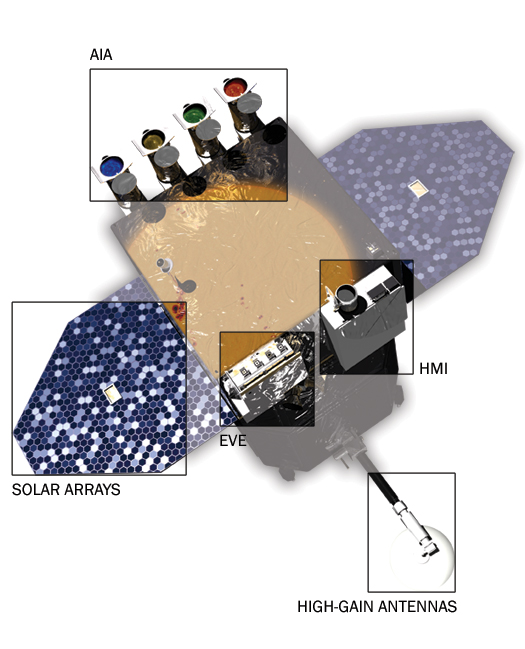
It is the first mission to be launched under the Living With a Star program and will present solar physicists with the highest spatial (4096x4096 pixels) and temporal (every minutes) resolution images of the Sun to date. The amount of data sent down to Earth will be equivalent to delivering 380 full length movies per day! The satellite is powered by two solar arrays and the data is beamed down to a ground station in New Mexico.
The main science goal of the mission is to further our knowledge of solar activity and how it influences the near-Earth phenomenon known as space weather. To do this, SDO carries three instruments:
Helioseismic and Magnetic Imager (HMI);
Extreme Ultraviolet (EUV) Variability Experiment (EVE);
Atmospheric Imaging Assembly (AIA).
By providing data detailed like never before this mission has importance not only to the scientific community, but for human technology that now relies upon satellite systems for communications, global positioning, etc. Such technology can be highly affected and possibly damaged during maximum periods during the solar cycle and it is a goal of SDO to predict when such activity may be directed towards the Earth so that we can take evasive action.


No comments:
Post a Comment